
What the Heat Reveals: A Drone Thermal Survey of Building Performance
Jan 29
/
Volatus Academy
This blog explores how drone-based thermal surveying can identify heat loss, roof moisture ingress, and façade defects in commercial buildings. Using high-resolution radiometric thermal data, the survey highlights how evidence-led diagnostics support targeted retrofit decisions and improved energy performance.
Introduction
With rising energy prices and increased pressure for UK businesses to decarbonize, drone-based thermal surveying has rapidly become one of the most effective techniques for diagnosing heat loss and assessing retrofit potential. Using a DJI Mavic 3T equipped with a 640×512 radiometric thermal sensor, this survey produced high resolution data that reveals the true condition of the building’s external envelope.
Thermal surveying is performed in accordance with established guidance such as BS EN 13187 and BRE IP 1/06, ensuring that all images are captured in stable environmental conditions and interpreted against known material emissivity and thermal behavior. Conducting the survey after sunset removed the influence of solar gain and allowed heat loss patterns to be detected with clarity.
Environmental Conditions & Methodology
To ensure accuracy, the survey was carried out after sundown when external temperatures were consistent and building surfaces had sufficiently cooled. Internal heating was operational, producing a temperature differential exceeding 10°C between interior and exterior surfaces—optimal for identifying heat loss.
The drone captured both nadir (downward) and oblique façade imagery. Radiometric R-JPEG files were used to allow precise temperature extraction. Emissivity was set at 0.92, suitable for most external building fabrics.
The drone captured both nadir (downward) and oblique façade imagery. Radiometric R-JPEG files were used to allow precise temperature extraction. Emissivity was set at 0.92, suitable for most external building fabrics.
Roof Thermal Analysis
The building’s roof exhibited a number of concerning thermal anomalies. The three rooftop images captured during the survey clearly show extended red and yellow thermal zones, which indicate localized heat retention and elevated surface
temperature. These patterns are typically associated with water ingress beneath an aging roof membrane.
When moisture becomes trapped beneath a roof membrane, the affected areas behave very differently from surrounding dry insulation. As the sun warms the roof during the day, the water stores thermal energy and releases it more slowly overnight. This creates a persistent warm signature on the thermogram—precisely the phenomenon seen in the images below.
These red/yellow zones therefore signify not simply heat loss, but a significant loss of roof integrity. The extent and shape of the warm areas strongly suggest that the insulation has become saturated, reducing its thermal resistance and potentially leading to long term structural deterioration.
This type of water driven thermal anomaly is one of the most important indicators in flat roof diagnostics and typically justifies intrusive inspection, core sampling or full roof membrane replacement depending on severity.
Write your awesome label here.
Write your awesome label here.
Write your awesome label here.
Façade Heat-Loss Assessment
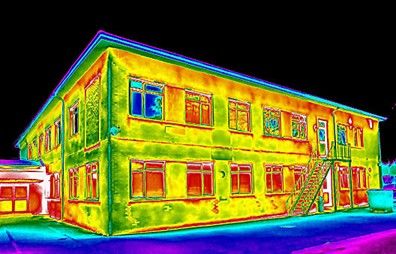
The façade thermal imagery shows heat loss concentrated around window frames, wall junctions and service penetrations. These elevated temperatures indicate thermal bridging, aged window seals, and likely air leakage paths. Variations in wall surface temperature also suggest uneven or degraded cavity insulation. Addressing these issues would significantly improve the building’s energy performance.
Retrofit Recommendations
Based on the thermal evidence collected, the following retrofit actions are recommended:
These measures would reduce heating demand, extend the lifespan of the roof structure, and support EPC improvement.
- Roof membrane replacement or refurbishment due to clear evidence of water ingress and insulation saturation.
- Full moisture survey using core samples or capacitance testing to map the extent of trapped water.
- Upgrade flat‑roof insulation, especially in saturated zones, to restore thermal resistance. Window and door seal replacement to address frame‑related thermal bridging.
- Cavity insulation assessment to identify voids or settlement. Air‑tightness improvements around penetrations, door frames, and service routes.
These measures would reduce heating demand, extend the lifespan of the roof structure, and support EPC improvement.
Budget Prioritization Through Data Review
Beyond identifying technical defects, reviewing the factual thermal data is essential for determining where limited budgets should be allocated for maximum impact. By quantifying the severity and extent of heat-loss pathways, thermal surveys allow building owners to prioritize expenditure on the areas that will deliver the greatest reduction in energy waste. This evidence-led approach is especially valuable and ensures that every pound is invested where it will produce measurable efficiency gains.
Conclusion
By addressing both the roof and façade deficiencies identified in this survey, the building owner can significantly reduce heat loss, lower operational energy costs, and plan targeted retrofit interventions aligned with UK energy efficiency standards.
Thermal Imaging for Business Professionals
For professionals looking to develop a deeper understanding of thermal imaging, our Thermal Imaging for Building Professionals course provides a practical foundation in building thermography.
The course is designed for surveyors, facilities managers, energy assessors, retrofit coordinators, inspectors, and maintenance professionals who want to confidently use thermal imaging to identify heat loss, insulation defects, air leakage, and moisture ingress—while avoiding common interpretation errors.
For further details or enrolment information, please get in touch.

We are an online educational platform that helps professionals and aspiring individuals to succeed in their goals.
Connect with us
Copyright © 2026
Write your awesome label here.
LEE DODSON
With 20+ years in advanced drone operations, Lee Dodson leads Volatus Academy’s specialized training for experienced pilots. Drawing from a background in offshore energy, engineering, and cinematography, Lee’s immersive, scenario-based approach prepares professionals for BVLOS, inspections, and complex missions. Learn from an industry leader known for real-world expertise, safety, and excellenc
Write your awesome label here.
Matt Johnson
Matthew Johnson, Vice President and Director of Education at Volatus Aerospace, leads the development of innovative drone education programs across North America. A Canadian Armed Forces veteran and former math teacher, he has been training drone pilots since 2015 and launched “Drones in the Classroom” in 2018. His programs now include Youth Drone Camps, the SEAR research initiative (backed by over $550,000 in grants), and MYdrone for middle-year students. A recognized industry speaker, Matthew has presented at leading conferences in Dubai, Las Vegas, New Orleans, and beyond, advancing the role of drones in education and technology.
Write your awesome label here.
Matt Johnson
Matthew Johnson, Vice President and Director of Education at Volatus Aerospace, leads the development of innovative drone education programs across North America. A Canadian Armed Forces veteran and former math teacher, he has been training drone pilots since 2015 and launched “Drones in the Classroom” in 2018. His programs now include Youth Drone Camps, the SEAR research initiative (backed by over $550,000 in grants), and MYdrone for middle-year students. A recognized industry speaker, Matthew has presented at leading conferences in Dubai, Las Vegas, New Orleans, and beyond, advancing the role of drones in education and technology.